Stopping by sofa on snowy evening.

A blog post from February…

One of the things I haven’t been really good at doing is staying home.  Don’t get me wrong, I am a bit of a homebody. But, since moving here, I’ve been trying to put myself out there a bit to meet new people, get involved in new activities, and see as much of the city and countryside as I possibly can.  But, because of the pending (well, not so pending anymore) inclement weather of SNOWMYGOD!, I couldn’t have been arsed today to leave and walk in the snow to go to a pub, to walk in the park, to head to the grocery store for the rations of Coke Zero, cranberry juice and vodka that I need to get through the day (kidding – well, at least on the alcohol).  Instead after doing half of my errands, getting my head shaved and beard trimmed at NV Barbers on in Shoreditch, eating a decadent lunch at Hawksmoor Spitalfields, I came home to my flat at around 1400.

I immediately became one with the sofa, remote in hand, rugby on the plasma screen, home knitted Afghan over my body, IKEA cushons under my head.  Since my lunch included two outrageously delicious classic cocktails: a Marmalade Cocktail to start, and a Corpse Reviver #2, I passed out on the sofa with a belly full of steak, eggs, chips and toast and a foggy head sleeping through most of the first match on BBC1 HD and the beginning of the second.  Strange dreams involving my friends from Michigan Peter, Rachel and Tarek, a marching band, Blackened Chicken Alfredo and Kirk Herbstriet ensued and I awoke a few hours later with absolutely no desire to go and do anything.

I know it sounds pretty boring and old fashioned, but, I couldn’t tell you the last time – even over the two week holiday break for Christmas and New Years – where I just stayed home, puttering around the house, and actually enjoying my own company, by myself.  I watched the first episode of the new series of Top Gear – a show both passionately loved and maligned, sometimes by the same person in the same breath.  It’s a car show for the petrol/gearheads and the average driver, with three hosts who are almost British institutions. I say almost, because every time that they come close to being loved and adored, they fuck it up with an off the cuff remark or insult to entire cultures or institution.  I personally love it, even though host Jeremy Clarkson offends people’s sensibilities on a regular basis. Don’t believe me?  look here, here, and here. Personally, I think they’re in on the joke, and use some of it for publicity.

I also ordered groceries using the Ocado on the go app for my Windows Phone 7.  I’ve spoken before about my unabashed love affair with Ocado, but, this smartly written, extremely reliable app allowed for me to not move my lazy day on the sofa to buy my food for the week and have some lovely delivery man cart it up here to my fourth floor flat – with minimal extra charge.  Tesco, Sainsburys and Asda also have similar delivery services, but the app made it seamless.  And it’s pretty. Oh, and did I mention? They deliver booze, too.

After the grocery ordering, I hunkered into leftover Indian takeaway, and switched TV gears – getting sucked into Casualty, a combination of EastEnders, General Hospital, ER and Touched by an Angel.  This trainwreck of a show gets high air time on a Saturday night – but most of the dialogue would make many English speaking authors cringe.  Combine it with the pathos and sturm und drang of American soap operas, and you have a Stilton fest extraordinaire.  Pull me away from the TV and force a classic book in my hand if it happens again.

All in all, a night home was pretty therapeutic in its’ own odd way. But, I can’t imagine I will make it a habit.

A hooligan’s sport played by gentlemen

Match Day

I’ve been in town a month today and it surprises me that is the first time that I am writing about this.

Rugby. A distinctly British sport, founded at the Rugby School in 1823.  One that I have played for the past five years. One that has brought me tremendous joy.  One that introduced me to some of my best friends in the world who I love absolutely and ferociously.  One that represents a culture of rugged athleticism, brotherhood, binge drinking, celebration and bawdy revelry with traditional songs, humor and purity of spirit.

Today I visited Twickenham, the spiritual and competitive home of English Rugby for the first time to see the Sale Sharks play the London Harlequins, as a guest of Ben Cohen.

Gay Icon and all around great man

Ben is a gifted professional rugby player happens to be dashingly handsome as well as a gay icon due to his commitment to tolerance and eliminating homophobia in sport, while being one of the most visible straight allies in the gay community.  He has done public service announcements and consistently walks the walk and talks the talk. Today also was the first union match for the second half of the season for my club, the club I led for the better part of the past three years, the Seattle Quake RFC.  The Quake was tied for second place going into today’s match and it made me pretty emotional to be five thousand miles away.  But more on Ben and the Quake’s match later…..

Twickenham is a village dedicated to rugby.  It is where the English international team plays, in a massive 82,000 seat stadium, as well as the London Harlequins Premiership pitch called the Stoop, an intimate pitch which seats 14,000. The fans are extremely dedicated, even down to the restaurants – with garden gnomes dressed in international rugby shirts in the windows.

South African Rugby Gnome

The weather was a beautiful day for rugby – chilly, misty, rainy – it makes the pitch softer when you get tackled, and it introduces a level of unpredicatbility into the play that makes for a more interesting match.  Rugby can be a brutal game, but is thrilling to watch and breathtaking to play.  Fifteen people on a muddy pitch of grass, relying on each other, their talent and grit to get the ball across the try line.  It is two halves of mostly non-stop action, with rules that are hard to learn at first, but basically boil down to a few key principles: stay behind the ball, do not pass forward and rely on your brothers to help you and the other fourteen of you on the pitch to get the ball across the line.  Yeah, yeah, there are penalties, conditions and rules of scrummage that you can learn on your own time. But, all you need to know is the heart and soul that breathes through the entire team.  On or off that field, you will do anything for them. It is what makes this game a sport, and turns boys into men, and men into athletes.

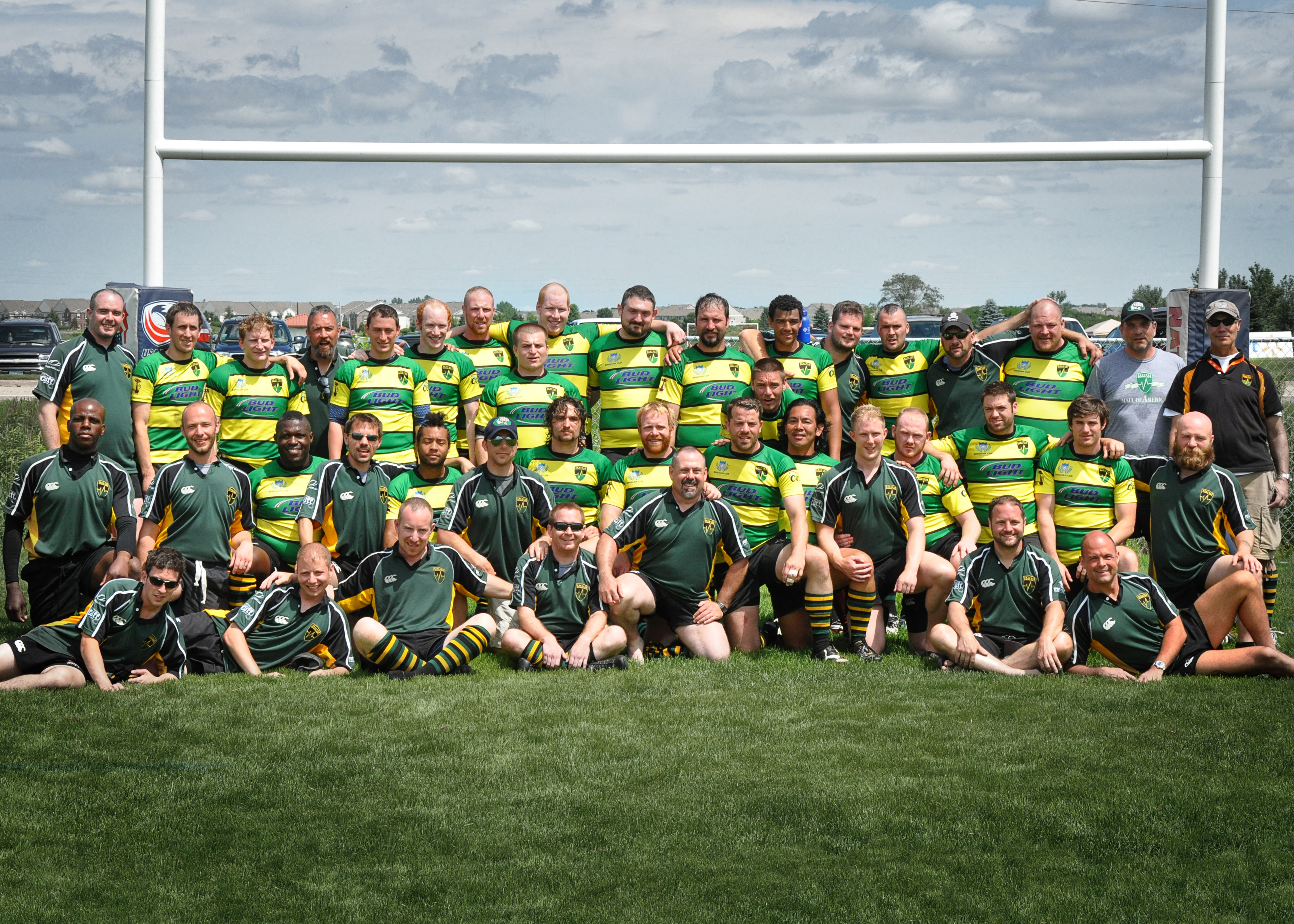
Seattle Quake at Bingham 2010

Given that, there are a couple things that make the Quake and others like them about more than rugby.  The Seattle Quake is a primarily gay team, started nine years ago in the spirit of Mark Bingham – killed in United 93 on September 11, of which the Bingham Cup gay rugby world championship is named.  The Quake stands for bringing rugby to underrepresented people in the sport – gay men and people of color – while being extremely competitive, community leaders and exceptionally open, showing that sexual orientation is a non-issue in sport.  Some of the most spirited about the issues of gay rights are the straight ally members of the club, bringing their children to events like Pride Marches, Fundraisers and team barbecues to teach them the values of tolerance and the importance of eliminating homophobia in sport, not just at the adult level, but in the schools as well.  The Seattle Quake also puts on the North American gay rugby championship in odd numbered years called Magnitude 15’s, a tournament I helped run in 2007 and hosted as President in 2009.   The next one is May 27-30, 2011.

Ben on the pitch at #11

Ben Cohen is coming to Seattle this year as a special guest of the Quake to Magnitude 15.11, hosted this year at Seattle’s Magnuson Park, home pitch of the Quake and one of only a few tournament rugby pitches in the state of Washington. Ben is in the process of starting a foundation that is dedicated to eliminating homophobia in youth, amateur and professional sports and has been recognized by GLSEN and one of their All-Stars, a program designed to recognize straight allies.  He happens to be the first international figure that they recognized due to his commitment to tolerance.  I met Ben in Manchester two weeks ago and I will sound like a total fan boy in my comments about him.  Ben is the athlete that every gay kid who was bullied in school wished would stand up for them.  He is a dedicated dad of twin girls, genuinely interested in everyone he meets, and exudes leadership quality from the words that come out of his mouth to his presence on the pitch and in any setting.  The depth of the conversation that we had about homophobia in sport and his commitment is beyond admirable, and extremely welcome.

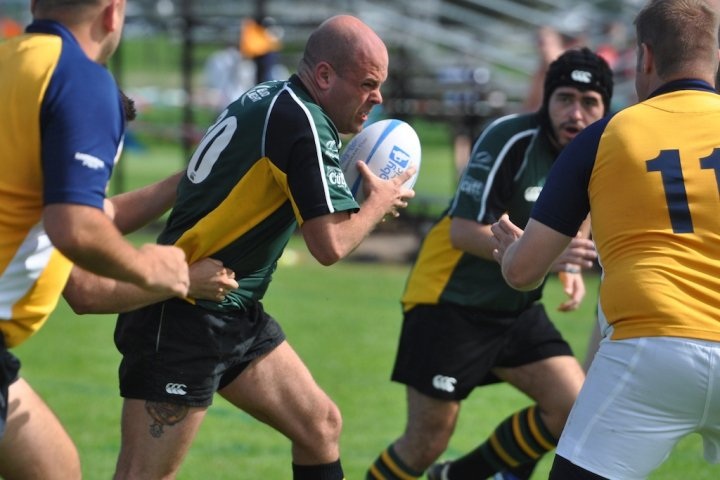
Me actually playing

Growing up, I had no gay athletic role models.  The stereotypes of gay people in 1970’s America were represented in popular culture by the celebrity images of Paul Lynde, Liberace and Charles Nelson Reilly – tarted up, self hating queens that would never have been caught dead playing a sport.  Those stereotypes were just as fake then as they are they are today, as none of those things truly reflected on the men that they were.  I was a gay kid who played hockey and figure skated (ok, yeah – huge stereotype there), but I was brought up with athletic ideals and the dichotomy did not make sense to me.  Why were there no adults who were like me who played sports?  Was it bad to be gay?  It took me years to reconcile my self image with the fact that I could be gay and an athlete and a leader in my communities AND be successful at it.  No child should ever have to go through that type of psychological chaos without the love and support of everyone around them. Ben Cohen and others like him show that it is possible to be extremely talented, while being very grounded and exceeding the expectations of the overall athletic ideals that my coaches taught me.  I am honored to know him.

Anyway, without rugby and the Quake, I would not be here on this wonderful experience in London.  The Quake and rugby have made me a better man, a better leader and a better person – one with a set of ideals and integrity that will make me successful in all that I do.  I can hardly contain myself for the Magnitude tournament in May, when so many powerful teams that support tolerance and bust stereotypes meet a very visible straight ally, fighting for their rights alongside them.

By the way, the Quake A side won their match today – 27-15, moving into an uncontested position at second place in the Pacific Northwest Rugby Union.  I could not be more pleased.

Zen and the Art of Underground Maintenance

Something you get used to pretty quickly here in London is the predictably unpredictable nature of public transportation here.   In the case of trains, there is the London Underground, the London Overground and National Rail – all of which are connected some ways, and in others could not be farther apart.  I have a romantic love for parts of the London Underground.  I would marry the Piccadilly line if I could, even though I do not live anywhere near close to that line.  However, the pace at which there are mass closures and upgrades makes one’s head spin in ways that you can’t imagine.

The London Underground, or the Tube as it is affectionately known, is one of the marvels of modern transportation engineering.  Started as the Metropolitan Railway in the 1840’s, it was designed as a way to funnel people quickly through the narrow streets of London, underground and in a relatively predictable manner.  There was a major run on developing many different lines through the city, none of which really had any organized way of urban planning or overall design.  This resulted in some of the haphazard lines running in strange ways with no rhyme, reason or linkages to each other.  Originally, the train stock was steam, with a later conversion to electric trains around the turn of the century.  The electrification allowed for more capacity and overall focus on service delivery. I could write multiple entries on the Underground alone, and most likely will at a later date.

There has been a lot of focus on improvement of the reliability of the equipment of most of the lines, stations and trains with the Olympics happening here in Summer 2012.  There are specific lines that need work or are never predictably reliable.  Specifically, the Hammersmith and City line and the Jubilee line are two lines that go down like a two dollar hooker.  Ironically, they are the oldest and newest train stocks, respectively, in the entire network.  (I do not count the Waterloo and City line, as I think it has been operational once in the past five years). Interestingly, what tube stop that you live near can make your life easier, or harder as the case may be.  If you move here, what zone you live in impacts how quickly you can get to and from the central city or what resources you may have at your disposal in a quick fashion.

In a nutshell, here’s a description of the lines in Central London which may be helpful if you travel here.

Bakerloo line – Short for Baker Street to Waterloo, which were the examples of its original termination points.  It is almost always reliable and runs from south of the river at Elephant and Castle up to some northern suburbs.  One of the unfortunate things about the Bakerloo line is that it has some of the loudest trains, especially when they put on the brakes.  It’s a bit maddening, sort of like nails on a chalkboard for three straight minutes while coming into a station.

Central Line – The Central line runs, you guessed it, right through central London, mostly under Bayswater Road, Oxford Street and New Oxford Street and then out to the distant eastern and western suburbs. This one is the closest to my flat, gets me from the West End or to Notting Hill Gate or Holland Park to my flat in about 10 minutes.  I never have issues on the Central line other than overcrowding on a morning rush hour.  Most of their deep level stations are decorated with the original white subway tile from the 1890’s.

Circle Line – The Circle line used to actually run in a circle, but now, the route looks like a backwards number nine.  It was actually nice before that it would go in a circle.  Now, you have to change at Paddington or Edgware Road to switch to the other train that will take you in a circular direction.  Most of these stations are above ground or with high retaining walls, shared with the District line and the Hammersmith and City line.  It basically makes a big circle around Central London, hitting most of the major National Rail stations like Victoria, Paddington, Euston and King’s Cross St. Pancras.  Unfortunately, this is one of the most popular tourist and commuter lines and is usually consistently busy.  Also, the Circle Line is one of the most unreliable and uncomfortable.  I usually avoid it if I can.

District Line – The District Line is less of a line than it is an octopus.  There are arms of the District Line that go all over the western, central and eastern parts of Metropolitan London.  If you so chose, you could go from Wimbledon in the south west, through Earl’s Court out to Upminster in the far northeast.  The District line shares tracks and train stock with the Hammersmith and City line and the Circle Line, so, you could be in for a treat of unbearable delays based on the color of your shirt or a change in the weather.  It is very convenient when it is up, however.

Hammersmith and Shitty Line – No, that is exactly what it is.  Old trains, never reliable and closed almost every weekend for refurbishment.  One would think that I would  like it because it is colored pink on the map.  But, sadly, no.  Avoid this line at all costs, unless you have to take the Metropolitan line which is also unbearable.  Problem is, that these lines represent the northern cross London east-west route.  You’re pretty much screwed if you live by Farringdon or Barbican.   Walk to a Central Line station if you can.

Jubilee Line – Ah, the young upstart that is pretty much run in an automated way.  I know it sounds rather Jetsons-ish, but, on the contrary.  Though the Jubilee line has been in place since 1979, and has the newest equipment, the Jubilee line has signal failures, coordination failures and equipment failures more often than my 1976 Ford LTD did in High School. When it works, it is very convenient, fast and clean and can get you to Canary Wharf in minutes from Central London.  It is also one of the lines that will run out to the Olympic park in Stratford in Summer 2012.

Metropolitan Line – The Metropolitan Line seems more like a suburban railway than an underground line, as most of the stations are above ground. The cars seem more like a rundown railway, with very old trains than a tube line that seems.  It does not go to many places that I go, so, I seldom take it.  If you want to go to some places that are very far out from central London, the Metropolitan Line will take you there.

Northern Line – The Northern Line seems like it should be two separate lines – one via Bank and one via Charing Cross Station.  It almost looks like a braided chain on the map.  It goes north/south from the south side of the river up through the City and Central London.  It’s a great way to get to places on the south side of the river, since I have friends who live in Clapham.  Usually, there are few issues, however, changing at some stations can be challenging due to how deep the tunnels are.

Piccadilly Line – My favorite line goes from Heathrow and Uxbridge to Cockfosters.  Any place called Cockfosters is up there in my book, both because I have the sense of humor of a ten year old boy, and I’m gay.  It sounds like the name of an Australian Bathhouse and Beer Bar.  Joking aside, it provides a cheap way to get from Heathrow Airport to many places in Central London.  It stops at some significant tourist destinations like Piccadilly Circus, Hyde Park Corner, Harrods, and King’s Cross/St. Pancras.  The line seems to be the one that has very few problems when you hear “There is a good service on the Piccadilly Line.” You hardly hear that it’s not working.  There are also some architecturally significant designed stations by Charles Holden on the Piccadilly Line, given that there was some major growth on the line in the suburbs in the 1930’s.  Some of the stations, like Southgate, Arnos Grove and Sudbury Town are excellent examples of quality, clean lines and Art Deco combined with Arts and Crafts.  I’ll most likely do a separate blog entry about that architecture as I go tour those stations.

Victoria Line – The Victoria Line was the first automated railway in the world, and the first deep line tunnel underground line in 60 years when it opened.  It works pretty consistently and makes a solid loop from the south side of the river to Walthamstow Central at the north.  At parts of it, it forms an express line that runs similarly to the Bakerloo line, for commuters going from Baker Street to Victoria.

Waterloo and City Line – I am not going to rant about this one, but, here’s a little story.  I visited London around twelve times over the past five years prior to moving here. In those five years, I never once saw the Waterloo and City Line open.  Not once.  It was always under refurbishment or down.  It is pretty much an express tram from Waterloo Station to Bank Station, enabling commuters to get to the City as quickly as possible. Otherwise, that trip would be a bit unbearable, having to go through eight stops and one or two changes.

Later on, I’ll talk about the Crossrail Projects, National Rail and the London Overground – all of which are generating a ton of infrastructure work in the current days especially as the time of the Olympics grows nearer.

Mind the gap!

Field Trip in East and North London

Liverpool Street Station Ironwork courtesy of Wikipedia
Wow, was Saturday a great day.
After feeling terrible and contagious on Friday, I met my Canadian rugby friend, David for a walk around East London.  We met at a Wetherspoon’s pub in Liverpool Street Station in the late afternoon.  Wetherspoon’s are like the McPub: big named lagers on tap, faceless, nameless service, non-descript food a flock of tourists at every turn.  Liverpool Street Station was built in the 1870’s on the site of the original Bedlam, yes, that Bedlam. And, while it is not as crazy as Waterloo or Victoria, it’s still the third busiest station in London.  Its Victorian architecture and ornate wrought iron design, gave meaning to the Victorian excess of the time, and is one of the best examples of that iron work left in the city today.
From there, we walked through Spitalfields Market, which on a Saturday afternoon, is completely empty – which was absolutely fine with me.  Even though it was empty, you could still get a pretty solid feel of what the environment is.  Spitalfields in the past had been a produce market, placed smack dab in the middle of the millinery district.  For years, it was the place where the weavers created most of the fabric, and the high street shops received what they needed to make clothing, draperies and tapestries.  In the 1600’s and 1700’s, the Spitalfields area was inhabited by Huegenots, who had brick homes on which they built an additional story to be able to capture as much light as possible to extend the work day and increase production.  Most of these brick homes had become pretty destitute in the 1970’s and 1980’s, as the area around Shoreditch became rife with crime and neglect.  Around that time, inspired artists and real estate speculators noticed these run-down brick homes with original 1700’s woodwork, in the simplistic Dutch Protestant style and the area started a resurgence.  Shops such as All Saints Spitalfields sprouted up and thrived and the area became a very trendy shopping and restaurant area. Nearby, you can get cheap clothing on Petticoat Lane, which historically was the resale area from the aristocracy. Think the Goodwill on steroids.
On Sundays, the Brick Lane market in the neighborhood is also there for shopping delight. This whole neighborhood is fascinating, as it was originally a  Protestant area, then a significant Jewish community with many older synagogues, and in recent times has been inhabited by Bangladeshi and South Indian Muslims.  One of the largest mosques in England is located in the neighborhood, close to the Aldgate tube station.  Brick Lane is home to a plethora of Indian, Pakistani and Bangladeshi restaurants, with the scents of spices, curry and roast meats wafting through the air at almost all times.  It is very hard to tell some of the restaurants apart, however, most places provide tasty South Asian food at reasonable prices.
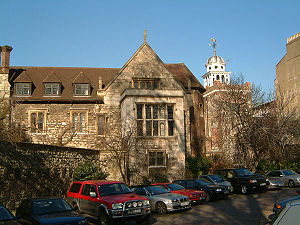
After leaving the Brick Lane area, we passed a former built in the Romanesque style, parts of which date from the 1300’s.  The Charterhouse is right on the outside of the City of London, and part of it is still used as a church, as well as a monastery. Ironically, it is where James I, the first combined regent of Scotland and England held court on his first visit to London.  It was partially damaged in WWI and WWII.  It is definitely a place I will visit again and tour.
Charterhouse courtesy of Wikipedia
From there, we walked through Smithfield Market which has amazing historic significance, both as a meat processing center as well as the place where William Wallace of Braveheart fame was hung in the 1300’s.  Again, there are some architecturally significant Victorian structures, which many developers would love to tear down and replace with mixed use buildings.  Ironically, Prince Charles is leading the charge to have these building recognized as historically significant, with some mixed success.  So far, his campaign is working, however, stay tuned.
From there, we walked by the Ten Bells Pub, one of the pubs famous for the Jack the Ripper murders, the Barbican Estate – an architectural monstrosity pretty close to the London Wall, some pieces of which date from Roman times.  The piece that we came close to was in this picture, and dates from the 13th Century. It is definitely fascinating to see such pieces of history next to some modern architecture.
London Wall near the Barbican
Then it was on to the Central Line tube, east to Tottenham Court Road Station.  I am a complete transit geek, as you will see in more posts on this blog.  The London Underground fascinates me with its history, disused stations, complexity and quirky service.  I have talked about the public transport here in another post, but, this time I was actually able to see a disused station from a line, thanks to David’s direction (he’s also a transit geek, so, we got along swimmingly).  The British Museum station was between Holborn and Tottenham Court Road, and closed in 1933 when the Holborn station was remodeled with new escalators instead of lifts.
We changed to the Northern Line to go to a pub in Kentish Town called the Southampton Arms. This pub has hand pumped ales and ciders that are all from independent brewers local to London.  As David said, it isn’t unusual for the farmer’s wife to come into the pub with a pony keg in the back of the truck, directly from the orchard or brewtank.  There were multiple different ciders and ales with not a lager in site.  It was 5pm, and the place was absolutely packed to the gills with everyone enjoying inexpensive, homecrafted ales and ciders in traditional public house fashion.  Great music, awesome conversation and people calling the barmaid “Luv”.  This place makes some of the brewpubs and local beer houses – even the famous ones in Portland, OR – look like a McBrewpub. And, yes, that’s amazing.
After two pints there, we headed down to Camden Town, which is where every 19-24 year old with a bit of money goes to get absolutely shitfaced, vomit in the streets, dance, listen to local rock bands and eat cheap Chinese takeaway after spending too much time and money in the pub.  Camden Market is the largest public market in London, and I will definitely check it out on a day that I have taken a ton of Xanax and I wish for lots of human contact with hipsters.  It will be like an afternoon in Belltown in Seattle.  We did have a pint at The Lock Tavern, definitely a hipster place, but I am a sucker for any place that plays 60’s B-side Soul.  We both had a bitter, and I saw Leonardo di Caprio heading upstairs to the VIP area as I was heading to the toilet.  Definitely hipster cred there.
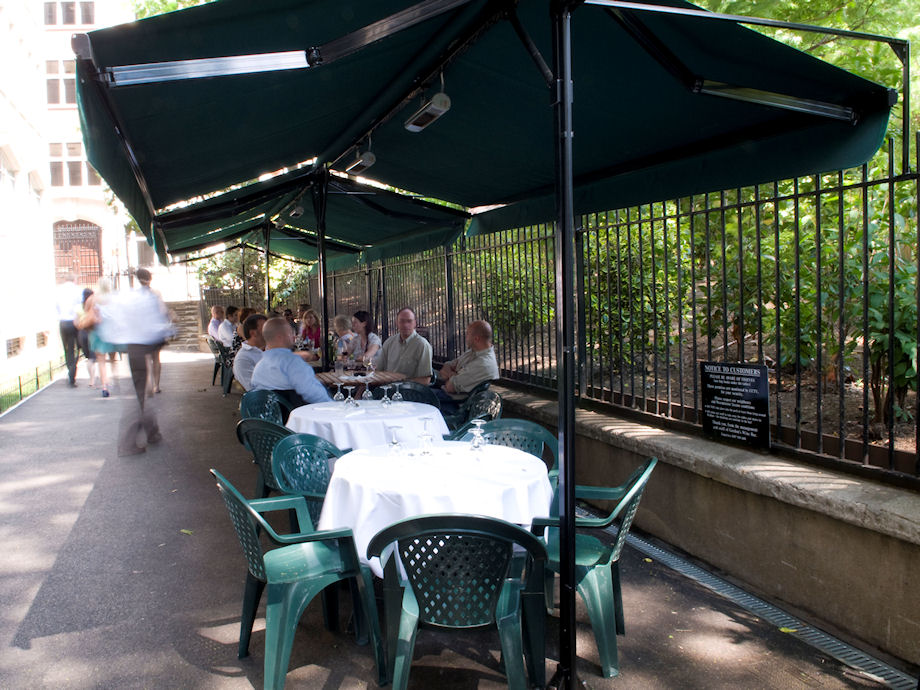
Gordon's Terrace courtesy of gordonswinebar.co.uk
From Camden Town, we headed south to Charing Cross Station to Gordon’s Wine Bar, London’s oldest wine bar since 1890.  Gordon’s has a cellar cave that used to open up to the Thames which would allow the tidal flow to move wine barrels into the cellar and then allow for them to be locked up and stored.  In present day, they also have a courtyard that has beautiful views of former boat docks for the Duke of Somerset.  It is a great place to drink a glass of port, even in 2 degree Celsius weather.
From there, we walked north to Soho to end the evening with the Kings Cross Steelers rugby team at the Duke of Wellington.  I met a few of the guys, and plan on going to training with them sometime soon.
This was a great field trip and definitely gave me a history lesson in some things that I normally would not have seen in London.