One of the things I haven’t been really good at doing is staying home. Don’t get me wrong, I am a bit of a homebody. But, since moving here, I’ve been trying to put myself out there a bit to meet new people, get involved in new activities, and see as much of the city and countryside as I possibly can. But, because of the pending (well, not so pending anymore) inclement weather of SNOWMYGOD!, I couldn’t have been arsed today to leave and walk in the snow to go to a pub, to walk in the park, to head to the grocery store for the rations of Coke Zero, cranberry juice and vodka that I need to get through the day (kidding – well, at least on the alcohol). Instead after doing half of my errands, getting my head shaved and beard trimmed at NV Barbers on in Shoreditch, eating a decadent lunch at Hawksmoor Spitalfields, I came home to my flat at around 1400.
I immediately became one with the sofa, remote in hand, rugby on the plasma screen, home knitted Afghan over my body, IKEA cushons under my head. Since my lunch included two outrageously delicious classic cocktails: a Marmalade Cocktail to start, and a Corpse Reviver #2, I passed out on the sofa with a belly full of steak, eggs, chips and toast and a foggy head sleeping through most of the first match on BBC1 HD and the beginning of the second. Strange dreams involving my friends from Michigan Peter, Rachel and Tarek, a marching band, Blackened Chicken Alfredo and Kirk Herbstriet ensued and I awoke a few hours later with absolutely no desire to go and do anything.
I know it sounds pretty boring and old fashioned, but, I couldn’t tell you the last time – even over the two week holiday break for Christmas and New Years – where I just stayed home, puttering around the house, and actually enjoying my own company, by myself. I watched the first episode of the new series of Top Gear – a show both passionately loved and maligned, sometimes by the same person in the same breath. It’s a car show for the petrol/gearheads and the average driver, with three hosts who are almost British institutions. I say almost, because every time that they come close to being loved and adored, they fuck it up with an off the cuff remark or insult to entire cultures or institution. I personally love it, even though host Jeremy Clarkson offends people’s sensibilities on a regular basis. Don’t believe me? look here, here, and here. Personally, I think they’re in on the joke, and use some of it for publicity.
I also ordered groceries using the Ocado on the go app for my Windows Phone 7. I’ve spoken before about my unabashed love affair with Ocado, but, this smartly written, extremely reliable app allowed for me to not move my lazy day on the sofa to buy my food for the week and have some lovely delivery man cart it up here to my fourth floor flat – with minimal extra charge. Tesco, Sainsburys and Asda also have similar delivery services, but the app made it seamless. And it’s pretty. Oh, and did I mention? They deliver booze, too.
After the grocery ordering, I hunkered into leftover Indian takeaway, and switched TV gears – getting sucked into Casualty, a combination of EastEnders, General Hospital, ER and Touched by an Angel. This trainwreck of a show gets high air time on a Saturday night – but most of the dialogue would make many English speaking authors cringe. Combine it with the pathos and sturm und drang of American soap operas, and you have a Stilton fest extraordinaire. Pull me away from the TV and force a classic book in my hand if it happens again.
All in all, a night home was pretty therapeutic in its’ own odd way. But, I can’t imagine I will make it a habit.
I am going to preface this entry with the fact that I am a bit of a beer snob. When I was in college, I never really drank beer until after my 22nd birthday. I just was not a big fan of it. It was because of my friend Iggy that I started drinking beer and it it all started with Watney’s Red Barrel, a pale lager that was put out by Sleeman Brewery from Canada in the early to mid 90’s. It was rather sweet and a bit unexpectedly refreshing, where the other beer I remember from keg parties or growing up was crap like Natural Light or Busch, which looked like urine, smelled like urine and pretty much tasted like I imagined urine would taste.
From there I branched out to Newcastle Brown Ale, other ales and stouts and ciders, such as Sierra Nevada Pale Ale, Samuel Smith and Guinness. So, I have actually looked forward to living in England for that reason. I also like wine and spirits a lot, but, I never get totally wasted or pissed when I drink beer as I usually get too full before that happens. Anyway, I digress.
I talked earlier on this blog about the fresh ale pub that my friend David and I visited when walking about London two weekends ago. There is a consumer advocacy group here called CAMRA, which runs the Campaign for Real Ale. Forty years ago this year, the organization was founded to protect consumers from the overcommercialization and vertical integration of the large breweries invading every pub in England, which had the potential to completely eliminate traditional and craft beers, ales and ciders from the market. Historically, small breweries would partner with local pubs in their towns to ensure there was fresh beer, locally brewed and at the peak of freshness. It was the sign of a well run local pub when there was community involvement from the brewer in the neighborhood.
Most pubs do have a hand pumped ale or bitter on tap now, thanks to the efforts of this group. Most of them are cask-conditioned, some are unpasteurized and lots of them have a much higher alcohol content than the Stella Artois’ and Carling’s of the world. In a sense, it is very similar to the microbrewery trend in the states, even though none of the beers are brewed onsite like the brewpub concept in the States.
Most times I go out, I do try to sample these local beers, to keep ensuring their production continues. Not that there is anything wrong with a nice Ice Cold Lager. In most case, British beer is served warm, but, thanks to the pressure of American and other expatriates, most pubs offer an Extra Cold option for staples like Guinness, Stella Artois and Carling. Otherwise, the temparature takes a while to get used to. If you don’t drink your beer quickly, it will get warm. As in room temperature warm. Guaranteed. Frankly, the ales and stouts taste better at that temperature. Both of them are pretty tannic and the colder they are, the more bitter they taste.
Also, British Round culture is staggering. It is a binge drinking culture that requires you to keep pace with everyone else in your party. If there are eight of you, you buy eight beers or ones for whoever is ready. And, that continues throughout the night. In some cases, I have not drank that much beer since right after college when I was trying to keep up with my significantly larger roommates. It is not for the faint of heart or liver for that matter, but, rugby may have trained me for this, no?
Liverpool Street Station Ironwork courtesy of Wikipedia
Wow, was Saturday a great day.
After feeling terrible and contagious on Friday, I met my Canadian rugby friend, David for a walk around East London. We met at a Wetherspoon’s pub in Liverpool Street Station in the late afternoon. Wetherspoon’s are like the McPub: big named lagers on tap, faceless, nameless service, non-descript food a flock of tourists at every turn. Liverpool Street Station was built in the 1870’s on the site of the original Bedlam, yes, that Bedlam. And, while it is not as crazy as Waterloo or Victoria, it’s still the third busiest station in London. Its Victorian architecture and ornate wrought iron design, gave meaning to the Victorian excess of the time, and is one of the best examples of that iron work left in the city today.
From there, we walked through Spitalfields Market, which on a Saturday afternoon, is completely empty – which was absolutely fine with me. Even though it was empty, you could still get a pretty solid feel of what the environment is. Spitalfields in the past had been a produce market, placed smack dab in the middle of the millinery district. For years, it was the place where the weavers created most of the fabric, and the high street shops received what they needed to make clothing, draperies and tapestries. In the 1600’s and 1700’s, the Spitalfields area was inhabited by Huegenots, who had brick homes on which they built an additional story to be able to capture as much light as possible to extend the work day and increase production. Most of these brick homes had become pretty destitute in the 1970’s and 1980’s, as the area around Shoreditch became rife with crime and neglect. Around that time, inspired artists and real estate speculators noticed these run-down brick homes with original 1700’s woodwork, in the simplistic Dutch Protestant style and the area started a resurgence. Shops such as All Saints Spitalfields sprouted up and thrived and the area became a very trendy shopping and restaurant area. Nearby, you can get cheap clothing on Petticoat Lane, which historically was the resale area from the aristocracy. Think the Goodwill on steroids.
On Sundays, the Brick Lane market in the neighborhood is also there for shopping delight. This whole neighborhood is fascinating, as it was originally a Protestant area, then a significant Jewish community with many older synagogues, and in recent times has been inhabited by Bangladeshi and South Indian Muslims. One of the largest mosques in England is located in the neighborhood, close to the Aldgate tube station. Brick Lane is home to a plethora of Indian, Pakistani and Bangladeshi restaurants, with the scents of spices, curry and roast meats wafting through the air at almost all times. It is very hard to tell some of the restaurants apart, however, most places provide tasty South Asian food at reasonable prices.
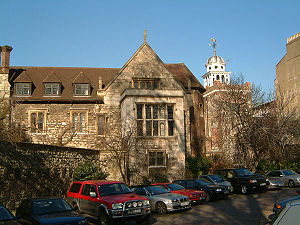
After leaving the Brick Lane area, we passed a former built in the Romanesque style, parts of which date from the 1300’s. The Charterhouse is right on the outside of the City of London, and part of it is still used as a church, as well as a monastery. Ironically, it is where James I, the first combined regent of Scotland and England held court on his first visit to London. It was partially damaged in WWI and WWII. It is definitely a place I will visit again and tour.
Charterhouse courtesy of Wikipedia
From there, we walked through Smithfield Market which has amazing historic significance, both as a meat processing center as well as the place where William Wallace of Braveheart fame was hung in the 1300’s. Again, there are some architecturally significant Victorian structures, which many developers would love to tear down and replace with mixed use buildings. Ironically, Prince Charles is leading the charge to have these building recognized as historically significant, with some mixed success. So far, his campaign is working, however, stay tuned.
From there, we walked by the Ten Bells Pub, one of the pubs famous for the Jack the Ripper murders, the Barbican Estate – an architectural monstrosity pretty close to the London Wall, some pieces of which date from Roman times. The piece that we came close to was in this picture, and dates from the 13th Century. It is definitely fascinating to see such pieces of history next to some modern architecture.
London Wall near the Barbican
Then it was on to the Central Line tube, east to Tottenham Court Road Station. I am a complete transit geek, as you will see in more posts on this blog. The London Underground fascinates me with its history, disused stations, complexity and quirky service. I have talked about the public transport here in another post, but, this time I was actually able to see a disused station from a line, thanks to David’s direction (he’s also a transit geek, so, we got along swimmingly). The British Museum station was between Holborn and Tottenham Court Road, and closed in 1933 when the Holborn station was remodeled with new escalators instead of lifts.
We changed to the Northern Line to go to a pub in Kentish Town called the Southampton Arms. This pub has hand pumped ales and ciders that are all from independent brewers local to London. As David said, it isn’t unusual for the farmer’s wife to come into the pub with a pony keg in the back of the truck, directly from the orchard or brewtank. There were multiple different ciders and ales with not a lager in site. It was 5pm, and the place was absolutely packed to the gills with everyone enjoying inexpensive, homecrafted ales and ciders in traditional public house fashion. Great music, awesome conversation and people calling the barmaid “Luv”. This place makes some of the brewpubs and local beer houses – even the famous ones in Portland, OR – look like a McBrewpub. And, yes, that’s amazing.
After two pints there, we headed down to Camden Town, which is where every 19-24 year old with a bit of money goes to get absolutely shitfaced, vomit in the streets, dance, listen to local rock bands and eat cheap Chinese takeaway after spending too much time and money in the pub. Camden Market is the largest public market in London, and I will definitely check it out on a day that I have taken a ton of Xanax and I wish for lots of human contact with hipsters. It will be like an afternoon in Belltown in Seattle. We did have a pint at The Lock Tavern, definitely a hipster place, but I am a sucker for any place that plays 60’s B-side Soul. We both had a bitter, and I saw Leonardo di Caprio heading upstairs to the VIP area as I was heading to the toilet. Definitely hipster cred there.
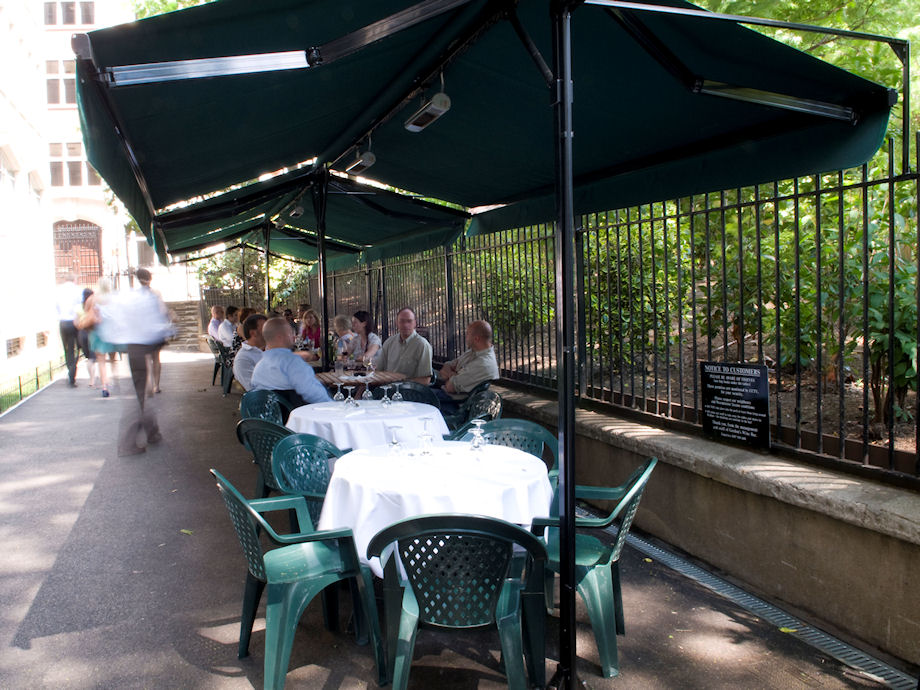
Gordon's Terrace courtesy of gordonswinebar.co.uk
From Camden Town, we headed south to Charing Cross Station to Gordon’s Wine Bar, London’s oldest wine bar since 1890. Gordon’s has a cellar cave that used to open up to the Thames which would allow the tidal flow to move wine barrels into the cellar and then allow for them to be locked up and stored. In present day, they also have a courtyard that has beautiful views of former boat docks for the Duke of Somerset. It is a great place to drink a glass of port, even in 2 degree Celsius weather.
From there, we walked north to Soho to end the evening with the Kings Cross Steelers rugby team at the Duke of Wellington. I met a few of the guys, and plan on going to training with them sometime soon.
This was a great field trip and definitely gave me a history lesson in some things that I normally would not have seen in London.



 American Expat in London
You must be logged in to post a comment.